Hutchinson County Courthouse (Stinnett)

Year Built: 1927
Architect: William Townes
🏛️ Hutchinson County Courthouse: A Testament to Boomtown Resilience in Stinnett, Texas
Stinnett, Texas — Tucked into the heart of the Texas Panhandle, Stinnett may be a quiet county seat today, but it wasn’t always so calm. During the oil boom years of the 1920s and 1930s, Hutchinson County exploded with growth, prosperity, and no small measure of lawlessness. The Hutchinson County Courthouse, a sturdy 1927 Classical Revival structure, rose from this boomtown era to bring order and permanence to a region in flux.
Today, the courthouse remains a striking architectural and civic landmark—a place where the rule of law still governs a county shaped by oil, grit, and perseverance.
Stinnett and the Rise of a Courthouse
Hutchinson County was organized in 1901, and for a brief time, the nearby town of Borger seemed poised to become the dominant hub of Panhandle oil. But in 1926, as wildcatters flooded into the county and Borger descended into lawlessness, Stinnett won the vote to become the permanent county seat. A year later, the Hutchinson County Courthouse was completed, offering both dignity and structure amid the chaos.
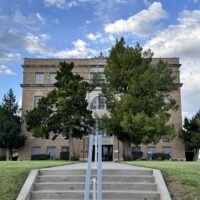
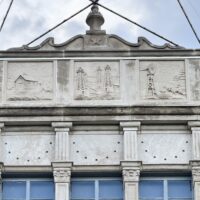
The courthouse was designed by Amarillo architect W. F. Townes, who gave the building a Classical Revival form rooted in symmetry and civic pride. It’s a three-story edifice made of buff-colored brick with limestone trim, boasting classical pilasters, arched windows, and a central entrance framed by ornamental detailing.
Though it’s not lavish, the design evokes a sense of stability—appropriate for a county dealing with rapid, and often volatile, growth.
Boomtown Law and the “Two-Gun Dick” Era
To understand the courthouse’s importance, it helps to know Hutchinson County’s early legal climate. In the late 1920s, Borger was infamous for corruption, bootlegging, and organized crime. The town earned national headlines for being one of the wildest places in Texas. Law enforcement was stretched thin, and at one point, the Texas Rangers were sent in to restore order.
The courthouse in Stinnett became a symbol of order and legitimacy—especially during the tenure of legendary Sheriff “Two-Gun” Dick Herwig, who helped clean up the county in the 1930s. His office and courtroom in Stinnett were ground zero for restoring legal authority.
Major criminal trials, oil-lease disputes, and property battles played out here, shaping the future of land ownership and oil development in West Texas. While the courthouse itself remained physically untouched by the surrounding chaos, it was deeply involved in resolving it.
An Active Civic Center
The Hutchinson County Courthouse continues to function as a full-service county government building. It houses the District and County Courts, County Clerk, Tax Assessor-Collector, and other administrative offices.
Though the interior has been modernized over the decades to include updated courtrooms and technology, many of the original design elements remain. The central stairwell, original terrazzo floors, and ornamental woodwork still echo the courthouse’s 1920s origins.
Outside, the courthouse lawn features a veterans memorial, manicured landscaping, and several benches where local residents gather on fair-weather days. The square is also home to parades, school band performances, and the occasional celebration of the area’s rich oil heritage.
Preservation and Recognition
In 2004, the Texas Historical Commission placed a marker at the courthouse recognizing its architectural and historical significance. Though not on the National Register of Historic Places, the building is celebrated locally as a symbol of the county’s evolution—from Wild West boomtown to law-abiding community.
The courthouse is also part of ongoing preservation discussions, as Hutchinson County explores ways to maintain its civic spaces without compromising modern functionality.
A Legal Perspective: When Stability Becomes History
As a real estate lawyer, I’m especially drawn to courthouses like Hutchinson County’s—buildings that emerged not from abstract architectural vision, but from urgent necessity. This courthouse wasn’t just a government project; it was a statement of legal permanence during a time of chaos and contested land rights.
The 1920s oil boom brought with it rapid claims, overlapping leases, and uncertain mineral rights. Many of those disputes were settled in Stinnett. The building’s Classical Revival design sends a message that justice, like architecture, requires foundations—strong, structured, and deliberate.
🔗 Visit the Official Site
To explore county government, records, and local history, visit the Hutchinson County official website.