

Every Texas Real Estate Broker Needs to Know This About Groundwater
By Trey Wilson, San Antonio Real Estate Attorney and Texas Water Lawyer
Water has become one of the most important issues in Texas real estate. It affects value, use, development potential, financing, disclosure, and risk. Yet many Texas real estate brokers still approach water as an afterthought. That is a mistake.
Across Texas, growth continues to push outward from the major metros into areas where municipal water service is limited or nonexistent. In many of those transactions, groundwater is the water supply. That means the deal may depend on a private water well, the right to drill one, the condition of an aquifer, or the rules of a local groundwater conservation district.
Those are not side issues. They are central to competent representation of a buyer or seller in a Texas real estate transaction. Getting this wrong could bring great peril to the brokers involved.
Texas uses roughly 15 million acre-feet of water each year, and groundwater remains a majority source of that supply. Official state sources also estimate that about 1.32 million Texans rely on private wells for daily drinking water supplies. In plain English, groundwater is not some niche rural area topic. It is a major part of how Texas lives, grows, builds, and sells land.
For brokers, that means groundwater knowledge has become part of competent deal handling. Buyers often assume water is available. Sellers often do not know the details. When those assumptions collide with the actual facts, the broker can end up in the middle.
Why Water Is a Real Estate Broker Issue
Every real estate professional in Texas understands that location matters. Water matters just as much. Plus, at their essence, water rights are property rights!
If a buyer is purchasing a rural tract, small ranch, residence on acreage, transitional development property, or suburban fringe land, water may be one of the first practical questions that needs to be answered. Is there an existing well? Is the well functional? Can a new well be drilled? Is the tract located inside a groundwater conservation district? Have groundwater rights been sold, leased, or severed from the surface estate? Is the property served by a shared water well arrangement that nobody bothered to document properly?
Those questions can affect whether a property is usable for residential purposes, whether livestock can be supported, whether a homesite is feasible, whether a lender gets comfortable, and whether a buyer later claims that material facts were not disclosed.
That is why water has become a broker issue. It is tied directly to marketability, usability, and liability.
Texas Has Two Water Systems With Two Different Legal Regimes
One of the first things a broker needs to understand is that Texas does not treat all water the same.
Surface water and groundwater follow different legal paths.
Under Texas Water Code Section 11.021, the ordinary flow, underflow, and tides of rivers, streams, lakes, bays, and certain storm and flood waters are the property of the State of Texas. The right to use state water is acquired by appropriation under Section 11.022, and the state holds those waters in trust for the public under Section 11.0235.
Groundwater is different. Under Texas Water Code Section 36.001, groundwater means water percolating below the surface of the earth. Under Section 36.002, the Legislature recognizes that a landowner owns the groundwater below the surface of the landowner’s land as real property.
That distinction is a big deal. Surface water is generally state-owned and permit-driven. Groundwater is treated as a private property right, subject to regulation. If a broker does not understand that divide, it becomes easy to speak too loosely and make bad assumptions in a transaction.
The Rule of Capture Still Matters
No discussion of Texas groundwater is complete without understanding the Rule of Capture.
The Texas Supreme Court’s decision in Houston & Texas Central Railroad Co. v. East, 81 S.W. 279 (Tex. 1904) adopted the Rule of Capture in Texas. In broad terms, the ancient common law rule allows a landowner to pump groundwater from beneath the land without liability to neighboring landowners, even if that pumping reduces the water available to others, absent recognized exceptions such as waste, malice, or other wrongful conduct.
This doctrine is often described as the “law of the biggest pump.” That description is blunt, but it gets the point across.
Texas has long favored strong private-property treatment of groundwater. That history still matters because it shapes how landowners, investors, and developers think about water. It also explains why groundwater can become contentious very quickly when large-scale pumping projects are proposed.
The Rule of Capture Is No Longer the Whole Story
Brokers need to understand something else: the Rule of Capture still matters, but it no longer tells the whole story.
Texas now operates in a world of regulated groundwater. That regulation comes largely through Texas Water Code Chapter 36 and the rise of local groundwater conservation districts, commonly called “GCDs.”
Chapter 36 states that GCDs are the state’s preferred method of groundwater management. Their role is to conserve, preserve, protect, recharge, and prevent waste of groundwater, while balancing property rights and the state’s water needs.
For brokers, the practical takeaway is simple. The existence of a groundwater right does not mean unrestricted freedom to drill and pump without regard to local rules. Instead, the rule of capture has been “modified” by the GCD scheme.
Depending on the property’s location, a GCD may regulate well registration, drilling permits, spacing requirements, production limits, transportation of groundwater, plugging requirements, monitoring, mitigation, and enforcement. The powers of GCDs vary. Their rules vary. Their local significance can be enormous.
That means a broker handling a transaction involving groundwater needs to know which district, if any, has jurisdiction over the property and what rules apply.
Groundwater Issues That Commonly Arise in Texas Real Estate Deals
In my experience, brokers most often encounter groundwater issues in three settings.
1. The Seller Has an Existing Well
When a property has an existing well, the right questions need to be asked early.
- Is the well currently in use?
- Is it functional?
- Has it been registered, permitted, or otherwise addressed under local GCD rules?
- Is it exempt or non-exempt?
- Are there well reports, driller records, repair records, or pump records?
- Is there evidence of water-quality problems, declining production, or equipment issues?
- Do the groundwater rights that support the well still travel with the surface estate?
That last point deserves special attention. In Texas, people tend to assume that if they buy the land, they get the groundwater. Sometimes that is true. Sometimes it is not. Groundwater interests can be conveyed, reserved, leased, or otherwise separated in ways that matter. A broker who never asks the question may walk a buyer into trouble.
2. The Buyer Wants to Drill a New Well
This scenario sounds simple until it is not.
A buyer may assume that a new well can be drilled because surrounding properties have wells. That assumption can fail for several reasons. The tract may be too small. GCD spacing rules may prevent the proposed location. Production limitations may make the expected use unrealistic. Water quality may be poor. Depth may make drilling expensive. Local geology may make results uncertain. Existing agreements or restrictions may complicate matters.
So the broker needs to push past optimism and get concrete information. Is a new well legally feasible? Is it physically feasible? What will it likely cost? Is the buyer expecting municipal-style certainty where none exists?
Those are real questions. They should be asked before the buyer is emotionally committed.
3. The Property Depends on a Shared Well Arrangement
Shared wells are common, and they are often poorly documented.
That creates obvious risk. Who owns the well? On whose property is it located? Is there a recorded easement for access and repair? Is there a recorded easement for water lines? Is there a written cost-sharing agreement? Who pays for electricity, pump repairs, or replacement? What happens if one owner wants to improve the system or one owner sells?
If a transaction involves a shared well, the broker should slow down and make sure the arrangement is documented in writing and supported by the necessary easements. Handshake water arrangements tend to look fine until somebody stops cooperating.
Water-Well and Groundwater Due Diligence Should Be Standard Practice
Texas brokers do not need to become hydrogeologists or water lawyers. However, they must stop treating water as background noise.
Reasonable due diligence may include reviewing available well reports, checking the applicable GCD, confirming whether the property lies in a certificate-of-convenience-and-necessity area, asking whether groundwater rights have been leased or sold, and directing clients to the right technical and legal resources before the deal advances too far.
The Texas Water Development Board offers useful groundwater tools and data. The Texas Commission on Environmental Quality provides information about locating water-well reports and related records. Local GCDs can often provide practical information about district boundaries, rules, and requirements. These are good places to start. They are not substitutes for legal advice, but they are part of basic diligence.
TREC Water Disclosures Have Raised the Stakes
The disclosure environment is changing, and brokers need to pay attention.
In 2026, the Texas Real Estate Commission adopted 22 TAC Section 537.68, creating a new form: TREC No. 61-0, the Water Notice: Seller’s Disclosure About Groundwater and Surface Water Rights. The point of the form – which is expected to take effect in May 2026 — is straightforward. Prospective buyers now receive more focused information about groundwater and surface-water rights tied to the property.
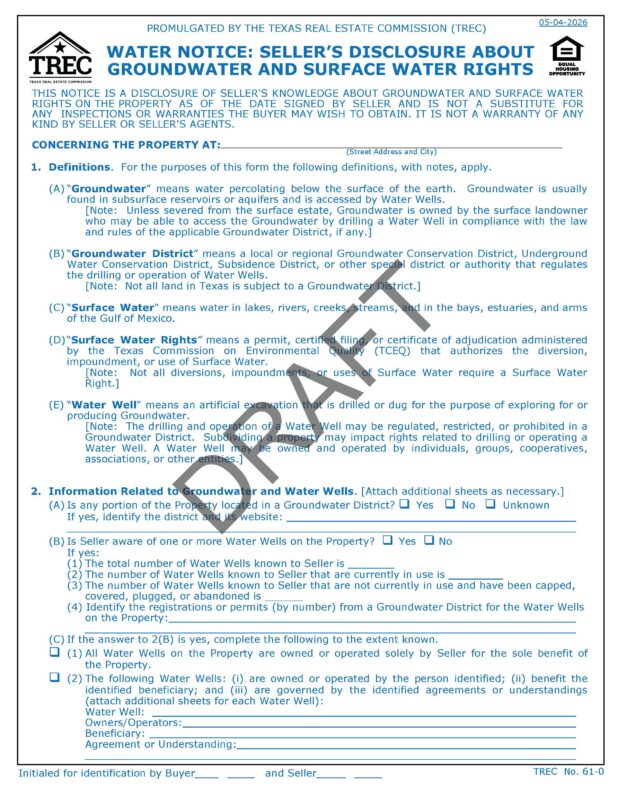
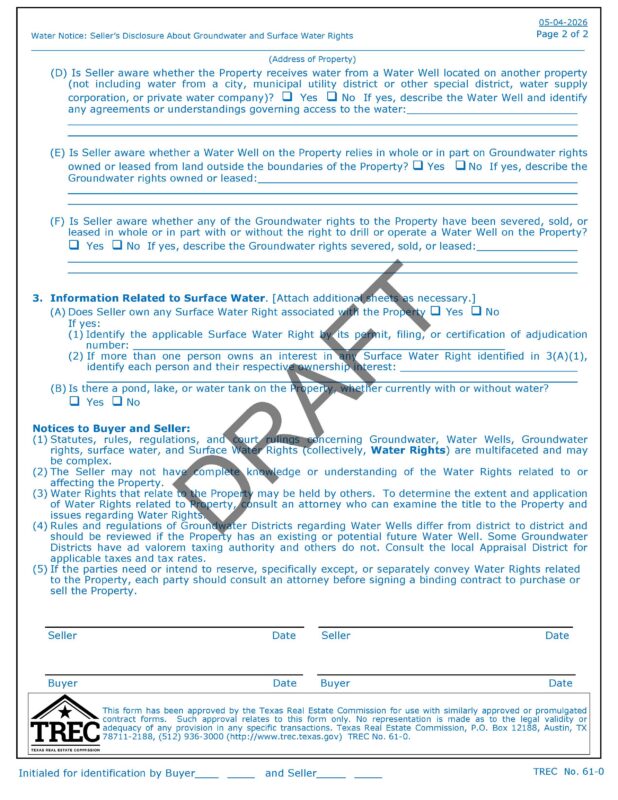
That matters because water problems are often hidden. A seller may know there is a well but know very little else. A seller may not understand whether a well is abandoned, shared, unregistered, or dependent on rights outside the tract. A seller may not understand whether groundwater interests were severed years ago in prior conveyances. Those are the kinds of facts that can create post-closing disputes.
Brokers need to appreciate the practical truth here. Many disclosure problems do not arise from fraud. They arise from ignorance, assumptions, and loose language. But ignorance does not make a problem harmless. It simply makes the resulting dispute more predictable.
Water disclosures should be treated with the same seriousness as flood history, boundary issues, easements, or structural defects. They can affect value, use, and litigation exposure.
What Brokers Should Do When Water Is Part of the Deal
When groundwater is part of the transaction, the broker should stay disciplined.
- Identify the water source early.
- Determine whether the property has an existing well, needs a new well, or depends on a shared arrangement.
- Identify the applicable groundwater conservation district, if any.
- Collect available records and well information.
- Do not make casual statements about water availability, production, or rights.
- Encourage the client to investigate before contingency periods expire.
- Direct the client to qualified legal or technical help when the facts get complicated.
That is not overkill. That is competent risk management.
Final Thoughts
Texas real estate professionals are working in a state where growth, drought, infrastructure strain, and rural development are all putting pressure on water. That pressure shows up in transactions. It shows up in disclosure. It shows up in development planning. And it shows up in lawsuits.
Brokers who understand groundwater issues are better equipped to protect their clients, preserve deals, and avoid preventable mistakes. Brokers who ignore groundwater are taking unnecessary risk.
Water has always been one of the real fault lines in Texas. That has not changed. What has changed is that groundwater knowledge has become far more important in ordinary real estate practice.
If you are handling Texas land or rural property transactions and have questions about groundwater rights, wells, disclosure duties, or water-related risk, it is smart to get clear answers before the deal turns into a dispute.
Trey Wilson has practiced real estate and water law for more than 20 years. He is based in San Antonio, but handles cases within his practice areas across Texas.