

Year Built: 1910
Architect: Chamberlin & Co.
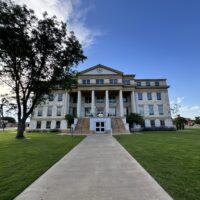
The Deaf Smith County Courthouse is located in Hereford, Texas.
🏛️ Deaf Smith County Courthouse: A Testament to Tenacity in Hereford, Texas
Hereford, Texas — Known as the “Beef Capital of the World,” Hereford is a city built on cattle, railroads, and wind-blown resolve. At the center of it all stands the Deaf Smith County Courthouse, a solid, three-story structure that reflects the sturdy, no-nonsense character of this Panhandle community. While the courthouse may not be the most ornate in Texas, its historical roots and civic importance run deep—just like the aquifers beneath the High Plains.
A 1910 Landmark in a Growing County
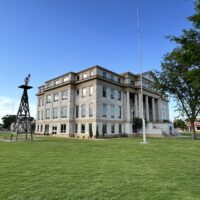
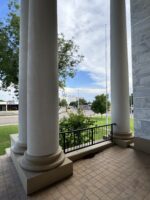
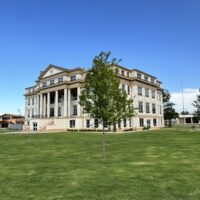
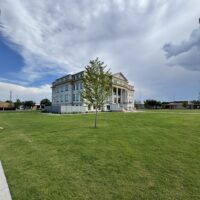
The current Deaf Smith County Courthouse, completed in 1910, was designed by architect E.L. Aiken in a restrained Classical Revival style. Built of buff brick with limestone trim, the building is marked by its clean symmetry, arched windows on the upper floors, and an understated sense of permanence. A small central dome once adorned the roofline, though it was removed in later decades.
When it was constructed, Deaf Smith County was transitioning from frontier ranchland to an agricultural powerhouse, thanks in large part to expanding irrigation and rail connectivity. The courthouse symbolized not only law and order, but a growing confidence in the county’s economic future.
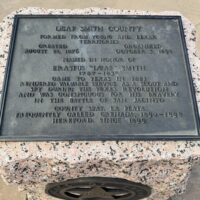
Who Was Deaf Smith?
Erastus “Deaf” Smith—pronounced “Deef” by many Texans—was a scout and spy for Sam Houston during the Texas Revolution. Despite losing most of his hearing due to illness, Smith proved invaluable at the Battle of San Jacinto, where his reconnaissance work helped secure Texas’ independence.
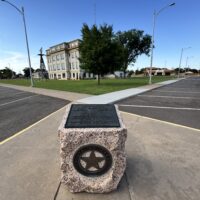
The county was named in his honor when it was created in 1876, and his legacy is felt throughout the region—from the courthouse itself to street names and school mascots.
A Courthouse of Local Legend and Legal Drama
Over the years, the Deaf Smith County Courthouse has seen its fair share of notable cases—many involving water rights, land sales, and cattle contracts, all central to the region’s agricultural economy.
One particularly memorable legal saga unfolded in the 1950s when disputes arose between feedlot owners and railroad operators over cattle shipping delays. The case, Gonzales Cattle Co. v. Santa Fe Rail Lines, became a benchmark ruling on contractual liability in livestock transport, influencing similar rulings across the state.
As a real estate lawyer, I find cases like these fascinating: they highlight the intersection of property law, commerce, and rural infrastructure—issues that continue to echo in contemporary land transactions and agri-business disputes.
Civic Life in the Courthouse Square
Like so many Texas towns, Hereford’s identity is tied to its courthouse square. The Deaf Smith County Courthouse lawn has been the setting for decades of civic activity—veterans’ ceremonies, livestock show celebrations, school band performances, and political stump speeches during campaign season.
During the Dust Bowl of the 1930s, courthouse steps became an informal gathering spot where locals shared updates, news, and hope. In that same spirit, the courthouse remains a symbol of collective resilience, especially through economic shifts and weather extremes.
Preservation and Function
The building still serves as the center of county government, housing the District and County Courts, Clerk’s Office, Tax Assessor-Collector, and other administrative departments. Though modest renovations have been made to maintain functionality, much of the original layout and character remains intact.
While discussions of full-scale restoration have been raised periodically, locals tend to prefer the courthouse just as it is: weathered, dependable, and full of stories.
A Legal Perspective: Where Justice Meets the Everyday
From a professional standpoint, the Deaf Smith County Courthouse represents the kind of working courthouse that forms the backbone of Texas legal life. Its design may be subdued compared to some of the more flamboyant courthouses elsewhere, but what it lacks in grandeur it makes up for in practical strength and historical continuity.
It’s a place where property deeds change hands, disputes are resolved, and generations of ranchers, clerks, and attorneys have done the quiet work of maintaining community order. In the world of real estate and rural land use, that kind of stability is priceless.
🔗 Visit the Official Site
To learn more about county services or local history, visit the official Deaf Smith County website.