
What if Data Center Lights or Noise Are Driving Me Crazy?
A Texas Landowner’s Guide to Private Nuisance, the Crosstex Standard, and When a Data Center’s Hum and Glare Cross the Line
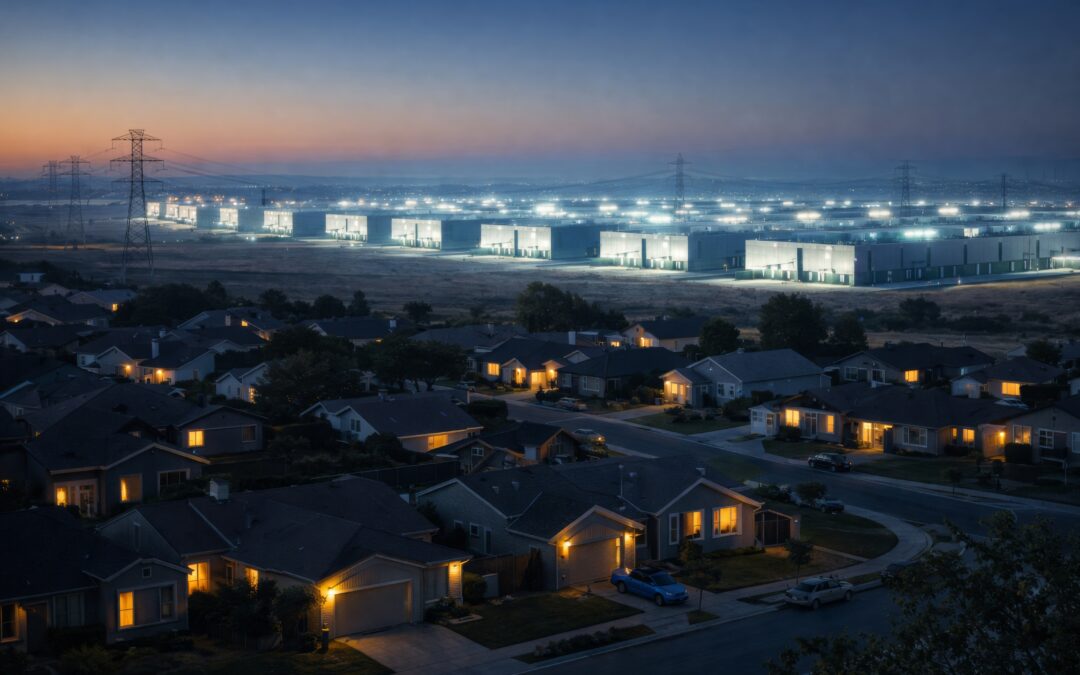
The data center went online, and now your nights are different. A low mechanical hum rolls off the cooling banks and never stops, day or night, and on a still evening you can hear it inside the house with the windows shut. A wall of security lighting throws a glow across your pasture and into the bedroom window that used to face nothing but dark. Once a month a bank of generators fires up for testing and rattles the coffee cups. You did not sell, nobody asked you, and now you are wondering whether the law does anything about it.
It might. Texas calls this a private nuisance, and the answer is almost never yes or no in the abstract. Whether a data center’s noise and lights are a nuisance is a fact question, and it turns on one thing before anything else: whether the interference is substantial. The law does not fix every annoyance that comes with a neighbor, and it will not act on a hum you can barely hear or a light you simply do not care for. It acts when the interference is real, serious, and would bother an ordinary person, not just you.
Quick Answers
Can a data center’s constant noise be a nuisance? Yes, if it substantially interferes with the use and enjoyment of your land and would disturb a person of ordinary sensibilities. A constant industrial hum is exactly the kind of thing Texas courts send to a jury.
Can the lights be a nuisance? It depends on what the lights do. Light that spills across your line and lights up your yard and your windows at night can be a nuisance. Simply being able to see a lit-up building on the horizon is not.
Do I have to prove the operator was careless or unreasonable? Not to show a nuisance exists. You prove that the effect on you is substantial and unreasonable to an ordinary person. Whether the operator acted intentionally or negligently is a separate question about who pays.
Is it enough that it really bothers me? No. The standard is objective. The question is whether it would bother an ordinary person in your shoes, not whether you are particularly sensitive to noise or light.
What kind of proof matters? Sound-level readings taken over time, light measurements, dated photos and video of the glare at night, a written log of when it happens, and evidence of lost property value. These cases are won with records, not adjectives.
How long do I have to sue? Generally two years, and when the clock starts depends on whether the nuisance is permanent or temporary. Do not sit on it.
What This Guide Covers
- The practical lesson: it depends on the facts, and the facts have to be serious
- What Texas means by a nuisance
- The interference has to be substantial
- It is judged by an ordinary person, not by you
- Noise: when the hum crosses the line
- Light: an invasion versus a view you do not like
- Every one of these cases turns on its own facts
- Suing before it is built is usually too early
- What you can recover, and the clock
- Start building your record now
- Frequently asked questions
- What this means for South Central Texas landowners
The practical lesson: it depends on the facts, and the facts have to be serious
I have practiced real estate and water law in San Antonio for more than a quarter century, and I have lived in South Central Texas my whole life. When a landowner calls about noise or lights from a project next door, the honest first answer is that it depends, and it depends more on the facts than on the law. Two neighbors can live beside the same data center and have completely different cases, because one sits a quarter mile downwind of the cooling banks with the lights washing over his house and the other is a mile away behind a rise. The law is the same for both. The facts are not.
So the useful way to think about this is not to ask whether a data center can be a nuisance, but whether this data center, on these facts, interferes with your land in a way that is substantial and that would bother an ordinary person. Get those two ideas in your head before anything else. Substantial, meaning serious and real, not a trifle. Ordinary person, meaning measured by normal sensibilities, not by how much it happens to bother you. Almost every one of these cases is won or lost on those two points.
What Texas means by a nuisance
You do not need a law school lecture to use this, so here is the whole framework in a paragraph. The Texas Supreme Court laid it out in Crosstex North Texas Pipeline, L.P. v. Gardiner, 505 S.W.3d 580 (Tex. 2016), a case about a gas compressor station whose engines ran day and night and produced a constant roar that neighbors compared to a jet or a locomotive. A nuisance, the Court held, is a condition that substantially interferes with the use and enjoyment of land by causing unreasonable discomfort or annoyance to persons of ordinary sensibilities. Id. at 593, 601. Two words carry the load. The interference must be substantial, and its effect on you must be unreasonable. And here is the part landowners get wrong: to show a nuisance exists, you do not have to prove that the data center’s operation was unreasonable or careless. You prove that the effect on you is unreasonable. Id. at 598 to 601. Whether the operator acted intentionally or negligently is a separate question that decides liability, not whether a nuisance exists.
That is as deep as we need to go into the doctrine. The rest of this guide is about how those two words, substantial and ordinary, decide real cases about noise and light.
The interference has to be substantial
This is the gate, and most cases that fail, fail right here. Crosstex put it plainly: the substantiality requirement sets a minimum threshold that confirms the law does not concern itself with trifles, or seek to remedy all of the petty annoyances and disturbances of every day life. Id. at 595. Growth is uncomfortable, and the law does not fix uncomfortable. It fixes serious.
Look at how Texas courts have sorted real disputes. On the side that cleared the bar, a neighbor whose late-night parties produced bass loud enough to physically shake homes three hundred yards away, destroying sleep, had a nuisance the court called more than a slight inconvenience or petty annoyance. Canales v. Vandenberg, 699 S.W.3d 666, 671 to 73 (Tex. App. Houston [14th Dist.] 2024, no pet.). Crosstex itself, the constant industrial roar, went to a jury. On the side that failed, a boathouse deck that only partly blocked a neighbor’s water view was not substantial and not an invasion of anything, so the nuisance verdict was reversed and rendered. Gulledge v. Wester, 562 S.W.3d 809, 815 to 16 (Tex. App. Houston [1st Dist.] 2018, pet. denied). And a claim built on dust and noise from a neighbor’s future subdivision, with no dates, no duration, and no measurement, was thrown out as speculative. Rec. Land Sales, LLC v. Allen, 2026 Tex. App. LEXIS 3216 (Tex. App. El Paso 2026) (mem. op.).
For a data center, the noise and light have to be measured against that threshold. A hum you notice on a quiet night may or may not clear it. A hum that runs around the clock, that you can hear inside with the windows shut, that keeps you or your family from sleeping, is the kind courts take seriously. The difference is not the label. It is the degree.
Substantial is a question of degree, and degree is a question of evidence. The landowner who says the noise is “unbearable” is describing a feeling. The landowner who can show a sustained sound level at the property line, night after night, and a sleep log, is describing a fact. Same complaint, very different case. Start measuring and writing things down before you ever call a lawyer, because the record you build early is the case.
It is judged by an ordinary person, not by you
The second idea is that the standard is objective. It does not matter that the hum drives you personally up the wall. The question is whether it would disturb and annoy a person of ordinary sensibilities, of ordinary tastes and habits. Crosstex, 505 S.W.3d at 599 to 600. If you happen to be unusually sensitive to noise or light, that is not enough. If an ordinary person living where you live would be seriously bothered, that is the case.
There is a practical reason the objective standard often helps the landowner. Crosstex recognized that a decline in the property’s market value can be evidence that the interference is substantial and objectively serious, not merely a personal irritation. Id. at 595. So proof that the data center next door has made your place harder to sell, or worth less, does double duty. It is both a measure of your damages and evidence that ordinary buyers, not just you, are bothered.
Noise: when the hum crosses the line
Noise is the strongest of these claims, because a constant, mechanical, around-the-clock sound is exactly what Texas courts have treated as a nuisance again and again. Crosstex was engine roar. In another case, air conditioning units loud enough to be heard indoors and to interrupt sleep, running alongside floodlights, were held to be a nuisance. GTE Mobilnet of S. Tex. v. Pascouet, 61 S.W.3d 599, 615 to 16 (Tex. App. Houston [14th Dist.] 2001, pet. denied). Swap the air conditioners for a hyperscale cooling plant and the generators for periodic load testing, and you have the same fact pattern at industrial scale.
The fight in a noise case is almost always about sound levels, and that is where the case is won or lost. In the wind-farm litigation the parties battled for pages over whether a decades-old federal guideline of fifty-five decibels, first identified by the U.S. Environmental Protection Agency, applied, and whether it had to be adjusted downward because the neighbors lived in a quiet rural setting rather than a city. Rankin v. FPL Energy, LLC, 266 S.W.3d 506, 513 to 15 (Tex. App. Eastland 2008, pet. denied). The lesson is that a neighbor saying it is loud will not carry a case. You need a qualified acoustic or sound expert taking readings at your property line, over time, and comparing them to what is reasonable for a quiet country setting. A single reading on one afternoon proves very little. A pattern of nighttime readings proves a great deal.
The number that matters is the level at your property line at night, in your setting, not a citywide average. Data center operators will point to a general decibel guideline and say they comply. The answer is that a level that is fine in a city can be a nuisance in the country, where the ambient background at two in the morning is close to silent. Build your proof around the difference between the site and the neighborhood, not around a single national number.
Light: an invasion versus a view you do not like
Light is where landowners most often misjudge their case, so this is the most important distinction in the guide. Texas does not recognize a nuisance based on how something looks. You cannot sue a data center because you can see it, because its glow sits on your horizon, or because you think it is ugly. The wind-farm court held it directly: Texas law does not provide a nuisance action for a project’s aesthetic impact, so a complaint that a facility changes the view or scenery of an area is not a nuisance. Rankin, 266 S.W.3d at 509, 512. That rule predates Crosstex and has survived it. The same court applied it again to reject a wind-farm nuisance claim built on the turbines being an eyesore that destroyed the scenic view, holding as a matter of law that aesthetic impact will not support a nuisance. Ladd v. Silver Star I Power Partners, LLC, 2013 Tex. App. LEXIS 6065, at 6 to 7 (Tex. App. Eastland 2013, pet. denied) (mem. op.). The reasoning is one worth understanding. If a neighbor’s lawful project were a nuisance simply because it spoiled your view, every landowner would hold a veto over how the people around him use their land, which is zoning by lawsuit, and Texas will not allow it. Id. at 512.
But there is a hard line between a view you do not like and light that invades your property, and the invasion is actionable. The same court listed the interferences the law does act on, light, sound, odor, and physical substances, and pointed to the floodlights in Pascouet that lit up the plaintiffs’ backyard all night. Bright lights, if sufficiently extreme, can be a nuisance even without any physical damage. Rankin, 266 S.W.3d at 510 to 12. So the question for a data center is not whether you can see the lights. It is whether the lights come onto your land. Security and operational lighting that washes across your pasture, floods your yard, and shines into the windows where you sleep is the kind courts act on. Our own San Antonio Court of Appeals proved the point on facts that translate almost directly. A neighbor’s sports-court lighting, sixteen fixtures on twenty-foot poles, spilled across the property line and lit more than half of the neighbors’ backyard and the inside of their house, bright enough that a witness compared it to living next to a stadium and bright enough to read a newspaper by at night, and the court upheld the finding that the lighting was a nuisance. Pauli v. Hayes, 2018 Tex. App. LEXIS 5440, at 25 to 27 (Tex. App. San Antonio 2018) (mem. op.). A lit building you can see across a field is not.
The recent cases hold that line on both sides. In a case over a rodeo arena next to homes, the neighbor whose backyard the arena lights actually reached, about forty feet from his fence, had a concrete enough injury to pursue his nuisance claim, while neighbors farther off did not. Schmitz v. Denton Cty. Cowboy Church, 550 S.W.3d 342, 361 to 63 (Tex. App. Fort Worth 2018, pet. denied). And in a 2024 wind-farm case, the court dismissed complaints about the turbines’ daytime appearance and the red aviation warning lights the Federal Aviation Administration requires, treating them as objections to the look of the sky rather than light shining into a home, and noting that the turbines sat a few hundred yards to more than a mile away and that the landowners did not even live on the tracts. Green v. Century Oak Wind Project, LLC, 2024 Tex. App. LEXIS 8623 (Tex. App. Eastland 2024) (mem. op.). Distance, direction, and whether the light actually reaches an occupied space are the whole game.
Call 210-354-7600 to talk with a Texas lawyer who represents landowners.
Representing Texas Land Owners. Not Data Center Developers.
Every one of these cases turns on its own facts
If there is one thing to take from the case law, it is that no two of these come out the same way, because the courts weigh a whole basket of facts. Crosstex listed them, and you can read them as a checklist of what will decide your case: how loud or how bright, how often, how long each episode lasts, how close the source is to where you live, the character of the neighborhood and what people there already put up with, whether others nearby are doing similar things, and the relative ability of each side to fix or avoid the problem. 505 S.W.3d at 600. A constant hum a few hundred feet from a farmhouse in quiet country is a different case from an intermittent sound a mile off in an area that already has highways and industry.
This is why a data center noise-and-light case cannot be evaluated from a distance or off a phone call. It has to be built from the specific facts of your property: where you sit, how far, which direction, what you can hear and see and when, and what the area was like before. The same complaint that wins for the neighbor at the fence line loses for the neighbor over the hill.
Suing before it is built is usually too early
Landowners often want to sue the day the data center is announced, or the day the dirt work starts. Usually that is premature. A nuisance is about interference you are actually suffering, and a facility that has not started operating has not yet interfered with anything you can measure. Courts have thrown out nuisance claims aimed at projects that were not yet built or fully operating, treating the harm as speculative and not ripe. In the 2026 subdivision case above, the neighbors’ fears about future homes, added traffic, and dust from development that had barely begun were held too speculative and hypothetical to support a ripe claim. Rec. Land Sales, 2026 Tex. App. LEXIS 3216. Fear of what a facility might someday do, without more, does not clear the substantial-interference bar.
There are real exceptions, and Crosstex recognizes that psychological harm to your peace of mind can be a genuine injury once the interference is real, 505 S.W.3d at 596, and Texas courts have let some claims proceed against a threatened, imminent nuisance. But the safe rule for most landowners is that your strongest case is built on what the operating facility actually does to your land, documented as it happens, not on what you fear it will do before it turns on.
What you can recover, and the clock
If you prove a nuisance, Texas gives you two kinds of relief. You can recover damages, measured by lost use for a temporary nuisance or lost market value for a permanent one, and in the right case you can get an injunction that limits the noise or the lighting. The Texas Supreme Court confirmed in 2024 that a court can order a defendant to abate a nuisance even where the jury found the nuisance temporary, because whether to grant an injunction and whether the nuisance is temporary are separate questions. Huynh v. Blanchard, 694 S.W.3d 648 (Tex. 2024). An order limiting light or noise has to be drafted with precision, though. The San Antonio court that upheld the sports-court light nuisance still threw out most of the trial court’s injunction as too broad and too vague and sent it back to be rewritten in clear, specific terms. Pauli, 2018 Tex. App. LEXIS 5440, at 28 to 44.
But the clock is unforgiving, and two Supreme Court decisions make the deadline everything. You generally have two years, and when it starts depends on whether the nuisance is permanent or temporary, the same fact-driven question we cover in our temporary-versus-permanent injury discussion. The Court drove the point home on facts that read like a data center dispute. Residents living within a half mile of four gas compressor stations complained for years about a constant roar one of them called louder than a jet engine at takeoff, yet the Court held their nuisance claims were time-barred, because a permanent nuisance accrues when the interference first becomes substantial, not when a landowner finally decides he has had enough. Town of Dish v. Atmos Energy Corp., 519 S.W.3d 605, 609 to 14 (Tex. 2017). And in 2026 the Texas Supreme Court closed the other escape hatch, holding that there is no stand-alone right to abate a nuisance, so once the two-year clock runs on your claim, it bars both your damages and any request for an injunction to make the noise or lights stop. Fam. Dollar Stores of Tex., LLC v. JLMH Invs., LLC, 2026 Tex. LEXIS 658, at 16 to 19 (Tex. 2026). You cannot count on asking a court to shut off the lights later if you let the deadline pass. Get advice while your claim is alive.
Start building your record now
Nuisance cases are won on evidence gathered while the problem is happening, not on a description given a year later. If a data center’s noise or lights are bothering you, start today.
- Keep a dated log. Every time the noise or lights interfere, write down the date, the time, how long it lasted, and what it kept you from doing. Sleep interruptions matter, so record those.
- Get sound readings over time. A qualified sound expert taking measurements at your property line, especially at night, is worth more than any adjective. One reading proves little. A pattern proves a lot.
- Measure and photograph the light. A light meter reading at your line and at the house, plus dated night photos and video of the glare from inside and outside, shows what actually reaches your property.
- Document what the place was like before. Anything showing how quiet and dark it used to be, older photos, video, a neighbor’s recollection, helps prove the change.
- Save every communication. Letters, emails, and notes of calls with the operator, with dates and names.
- Watch the calendar. The two-year deadline can start sooner than you think, and once it runs it takes your injunction with it. Do not wait to see whether it gets better on its own.
- Talk to a Texas lawyer who handles nuisance and land disputes before the record goes cold.
Frequently Asked Questions
Is a 24-hour hum from a data center automatically a nuisance in Texas?
No, nothing is automatic. It is a fact question. A constant, around-the-clock mechanical noise is the kind of thing Texas courts treat seriously, but you still have to show the interference is substantial and would bother a person of ordinary sensibilities, usually with sound readings taken over time.
Can I sue a data center just because I can see it lit up at night?
No. Texas does not recognize a nuisance based on how a facility looks or on the mere sight of its lights. What is actionable is light that invades your property, that floods your yard and shines into your home. The line is between a view you dislike and light that crosses your fence.
Do I have to prove the data center is being run carelessly?
Not to show that a nuisance exists. You prove the effect on you is substantial and unreasonable to an ordinary person. Whether the operator acted intentionally or negligently is a separate question that goes to liability, and you can often reach the operator on either theory.
The operator says its noise and lighting meet code. Does that end my case?
No. Meeting a permit or a code standard is not a defense to a private nuisance, and a sound level that is acceptable in a city can be a nuisance in a quiet rural setting. Compliance is a fact in the mix, not the end of the analysis.
Can I stop the data center from ever being built because I am worried about the noise and lights?
Usually not through a nuisance suit. Courts generally treat harm from a facility that is not yet operating as speculative, so your strongest case is built on what the running facility actually does to your land. Waiting for it to operate is not the same as sleeping on your rights once it does.
What this means for South Central Texas landowners
Data centers are landing across Bexar, Medina, Comal, Guadalupe, and Atascosa Counties, and with them come cooling plants that never shut off and lighting that never goes dark. If that is now your nightly reality, Texas nuisance law may help you, but it is not a cure for every annoyance. It acts when the interference is substantial and would bother an ordinary person, and it draws a hard line on light between what invades your property and what merely offends your eye. Whether you have a case is a fact question, and the facts are yours to prove: how loud, how bright, how often, how close, and how much it has changed the place you live.
Because it is a fact question, the landowners who succeed are the ones who start documenting early, measure the noise and the light instead of just describing them, and get advice before the two-year clock runs and takes their remedy with it. If the hum and the glare have taken over your nights, do not wait to see whether you get used to it.
This guide is part of our data center landowner series. If you are living next to a project and dealing with more than noise and lights, see our broader guide to living next to a data center. If the problem is water rather than noise, see our guide to what happens when data center construction floods your land. And for more on the high bar Texas sets, see our discussion of why a nuisance must be more than visual.
Call 210-354-7600 to talk with a Texas lawyer who represents landowners.
Representing Texas Land Owners. Not Data Center Developers.