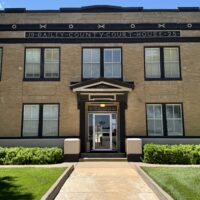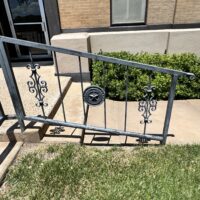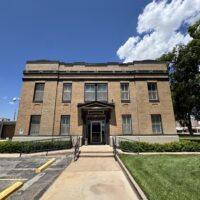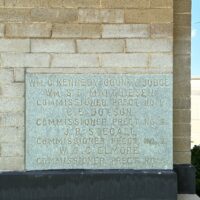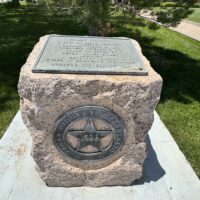
Bailey County Courthouse (Muleshoe)
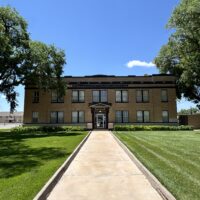
Year Built: 1925
Architect: M. C. Butler
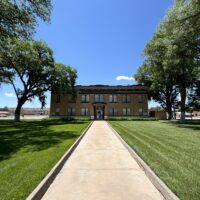
The Bailey County Courthouse was built in Muleshoe, Texas.
Bailey County Courthouse: Justice on the South Plains Frontier
Muleshoe, Texas — If you’ve ever traveled the wide and quiet plains of far West Texas, you’ll know that the wind speaks volumes—and in Bailey County, it carries stories of ranchers, railroads, and the enduring presence of the county courthouse, standing firm in the heart of Muleshoe.
A Prairie Courthouse with Quiet Dignity
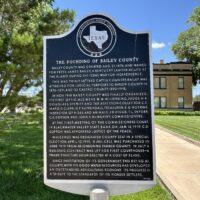
The Bailey County Courthouse, completed in 1917, is a modest but enduring example of Classical Revival architecture. Its original structure replaced a much simpler wooden courthouse that had served since the county’s formation in 1919 (formally organized in 1919, but named for Peter Bailey, a defender at the Alamo).
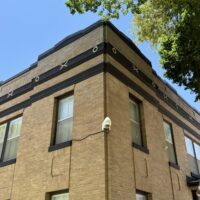
Designed by architect W.M. Rice, the building is a two-story masonry construction with traditional symmetry, stone details, and a measured sense of formality. While it doesn’t boast grandiose towers or ornate sculptures like some of its cousins in East Texas, its quiet, symmetrical design commands respect—a no-nonsense building for a no-nonsense community.
A later renovation in the 1950s introduced some updates, including a simplified façade and modern window frames, reflecting the evolving tastes and needs of the time.
Historical Significance: Railroads, Ranches, and the Rule of Law
Bailey County’s development hinged on the arrival of the Santa Fe Railroad in the early 20th century. As the population grew, so did the need for formal legal infrastructure. The courthouse quickly became more than a place of law—it served as a political gathering point, a backdrop for local parades, and even an unofficial town square.
One of the more significant episodes in the courthouse’s history involved a series of land ownership disputes in the 1920s and 1930s, stemming from overlapping property claims during railroad expansion. Several high-stakes civil trials were heard in the courthouse that shaped the legal contours of land use in the region—something a real estate lawyer would certainly find compelling.
Local legend also recalls a case in the early 1940s involving a cattle rustling ring that extended across three counties. The Bailey County Courthouse was the central venue for the trial, which attracted ranchers and reporters from all over the South Plains.
The Courthouse Today: Civic Symbol & Local Landmark
Today, the Bailey County Courthouse remains an active center of county government, housing the County Judge’s office, County Clerk, and other essential departments. Though smaller than many Texas county seats, the courthouse remains a point of pride for Muleshoe residents.
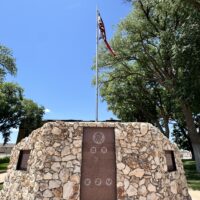
The surrounding courthouse square is understated but inviting, often used for community events, Veterans Day ceremonies, and the occasional high school photo shoot. Visitors often combine a stop at the courthouse with a trip to the Muleshoe National Wildlife Refuge, just south of town—making for a uniquely West Texas day trip.
A Lawyer’s Reflection: The Ground Beneath the Gavel
As a Texas real estate attorney, I find courthouses like Bailey’s especially meaningful. They may not be architecturally flamboyant, but they reflect a time when counties grew out of cattle trails and barbed wire lines. Standing on the courthouse steps, you can feel the presence of those early settlers—resolute in their belief that law and order belonged even out here, where the land stretches endlessly and the horizon never blinks.
It’s a reminder that legal history isn’t just written in books or city chambers—it’s also shaped in these humble but essential county courthouses.
🔗 Visit the Official Site
To learn more about Bailey County and courthouse services, visit the Bailey County official website.